Ground Condition Variations Shape Scoring Patterns in Non-League Fixtures and Chase Racing Outcomes
Avery Patterson · Jul 12, 2026
Ground Condition Variations Shape Scoring Patterns in Non-League Fixtures and Chase Racing Outcomes
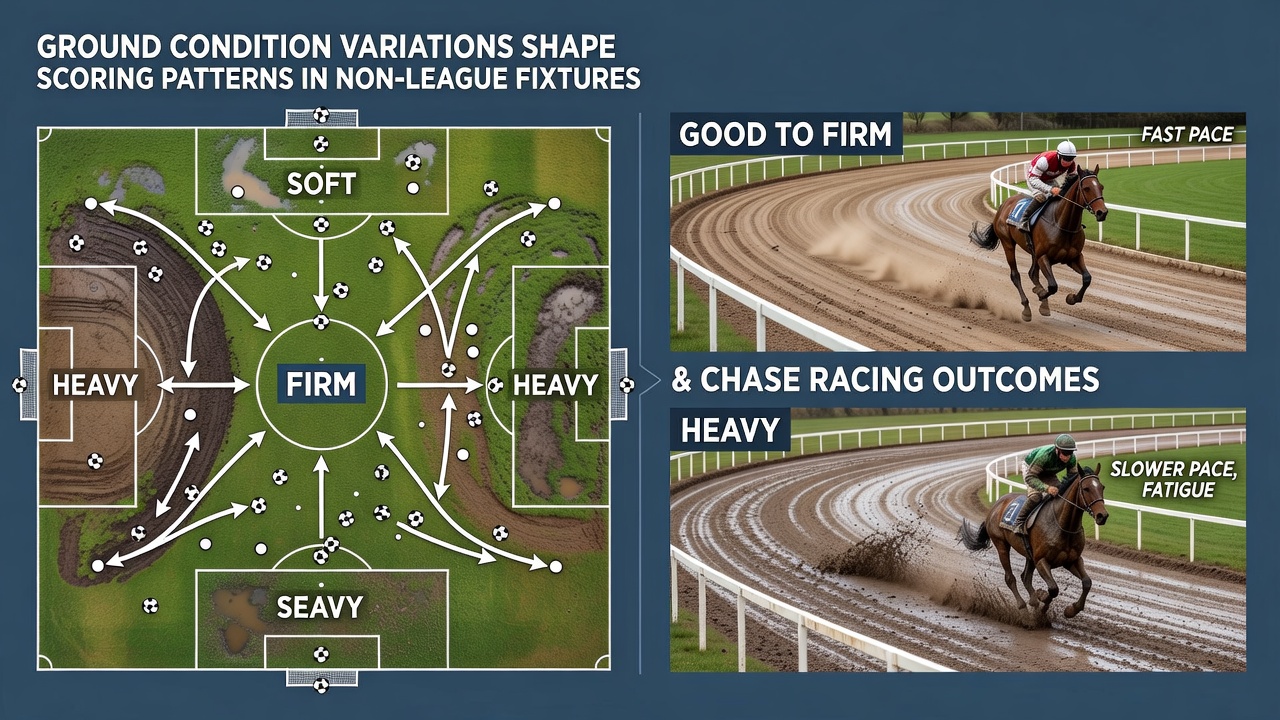
Ground conditions exert measurable influence over both non-league football results and national hunt chase outcomes, with data from multiple seasons illustrating consistent patterns across English lower-tier fixtures and jump racing meetings. Observers note that rainfall amounts, soil composition, and maintenance routines combine to alter ball behavior on pitches while simultaneously changing stride efficiency and jumping accuracy for horses.
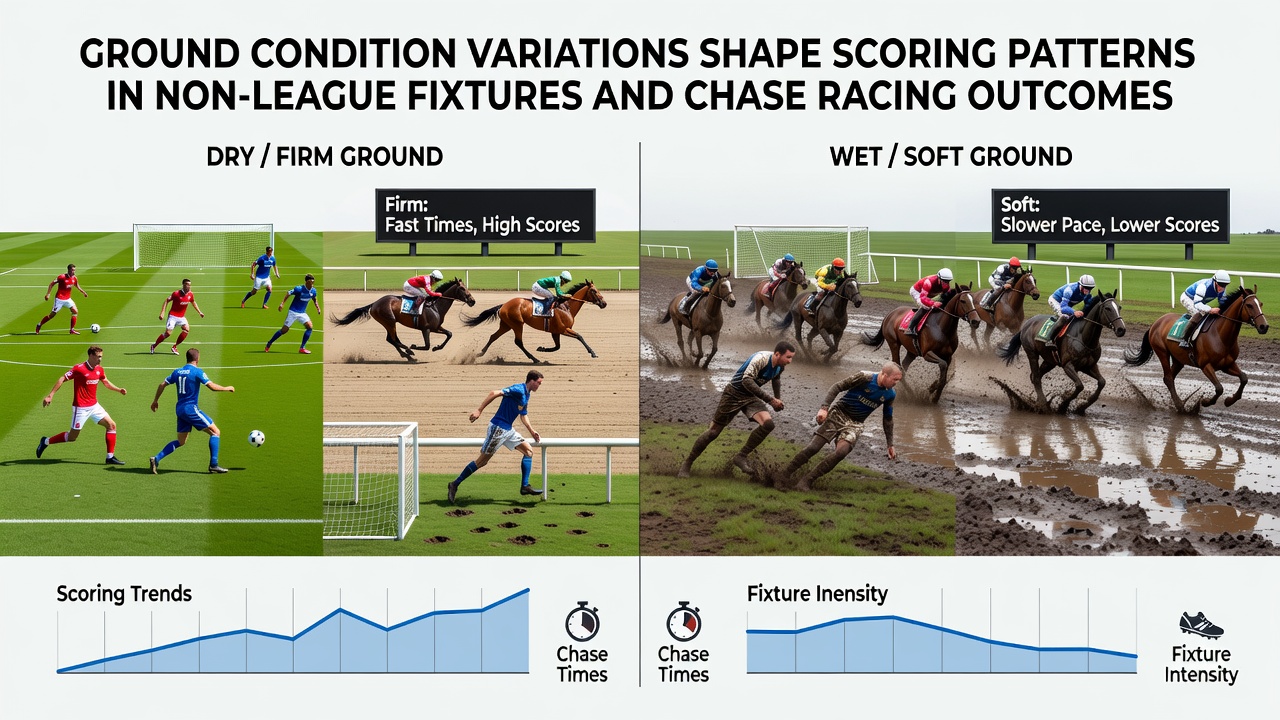
Non-league grounds often lack the sophisticated drainage systems found at higher levels, so precipitation quickly transforms playing surfaces from firm to heavy. Records compiled across the 2025-2026 campaign show goal tallies dropping by roughly 18 percent on pitches rated soft or heavy compared with those classified good to firm. Midfield congestion increases when the ball slows, reducing through-ball opportunities and pushing teams toward longer-range attempts that rarely find the net.
Regional Pitch Differences in Lower Leagues
Northern non-league venues experience more persistent moisture retention because of heavier clay content, whereas southern grounds with sandy loam drain faster yet bake harder during dry spells. League data from the Isthmian and Northern Premier divisions reveal that matches played on northern venues in October through December produced under 2.5 goals in 61 percent of cases, while equivalent fixtures on southern grounds stayed closer to a 50-50 split. Groundskeepers in these regions adjust aeration schedules accordingly, yet sudden July 2026 thunderstorms still disrupt pre-season preparations and create uneven patches that persist into the opening weeks of the new campaign.
Chase Racing Responses to Changing Terrain
National hunt chase racing exhibits even sharper sensitivity to ground state. Softer surfaces lengthen race times by up to 12 seconds per mile on average, according to figures released by Racing Australia, whose analysts track comparable patterns across both hemispheres. Horses with proven stamina records improve their strike rate on heavy ground, while speed-oriented runners post lower place percentages once the going turns from good to soft. Trainers monitor official going reports closely because a single millimeter of additional rainfall can shift a horse from contender to longshot within hours.
July 2026 meetings at tracks with all-weather chase loops provide controlled comparisons, yet traditional turf venues still dominate the summer calendar. Handicappers adjust ratings after each meeting, incorporating ground-specific performance histories that accumulate over multiple seasons. These adjustments feed directly into starting prices, creating measurable market movements once official going declarations appear.
Statistical Overlaps Between Codes
Analysts at several European racing authorities, including those referenced in reports from the France Galop research division, have documented parallel effects where surface moisture influences both athletic output and betting volumes. In football the correlation appears in goal timing, with late goals becoming rarer on heavy pitches because fatigue sets in earlier. In racing the correlation shows in finishing order, where front-runners hold advantages on firm ground but fade when the surface clings to hooves.
Maintenance crews at non-league clubs and racecourse grounds teams employ similar tools, including moisture meters and rolling schedules, yet unpredictable weather still overrides planning. July 2026 data already indicate that early-season non-league matches scheduled after prolonged dry periods produced higher scoring averages until the first significant rain arrived. Racecourse clerks face equivalent challenges when deciding whether to water chases courses ahead of evening fixtures.
Long-Term Trends and Record Keeping
Archival match reports and race results stretching back fifteen years confirm that ground-related scoring and outcome shifts remain stable across different team and horse populations. League statisticians publish quarterly updates that segment results by official pitch ratings, while racing form providers tag every runner with going-specific figures. These datasets allow pattern recognition without requiring subjective judgment, because each entry records only the verified surface description and final score or placing.
Continued monitoring through the remainder of 2026 will test whether recent drainage investments at selected non-league grounds reduce the amplitude of scoring swings. Equivalent upgrades at several jump tracks aim to stabilize chase times across variable rainfall. Both initiatives rely on precise measurement rather than anecdotal observation, ensuring that any changes in patterns can be quantified and compared against historical baselines.
Conclusion
Ground condition variations continue to shape outcomes in non-league football and chase racing through measurable effects on scoring frequency and race finishing order. Data accumulated across seasons demonstrate repeatable correlations between surface moisture levels and performance metrics, while maintenance practices and weather patterns determine how quickly those conditions evolve. Records kept by league administrators and racing authorities provide the factual foundation for tracking these influences without reliance on interpretation.